How engineering revision errors cause late builds
The engineering team has released a new revision. Procurement still has the previous BOM export. A similar component is already on the shelf. The workshop has a printed copy saved beside the works order. Nobody has made a dramatic mistake, but the project no longer has one reliable view of what is approved and what has already happened.
Direct answer
Revision errors spread when a design change is controlled inside engineering but its consequence is not connected to the operational BOM, purchasing records, stock, build activity and documentation. The result is a chain of reasonable local actions based on different versions of the truth.
Revision errors rarely begin with one serious mistake
It usually grows through a series of small disconnects. A component or tolerance changes. The operational BOM is not updated or the change is transferred without explanation. A buyer cannot see an existing commitment. Stock records show quantity but not engineering intent. The workshop continues from an issued file. The delivery pack is assembled later from folders.
Each team may believe it is working from the best information available. The problem is that the project cannot answer three basic questions quickly: What changed? What has already happened downstream? What must happen next?
The six-stage cost chain
- Design: a new revision is created, but the operational release state is unclear.
- BOM: the live project structure does not show what was added, removed, replaced or changed in quantity.
- Procurement: the wrong part is ordered, a needed order is cancelled or the same requirement is purchased twice under different references.
- Stock: an obsolete or unsuitable item remains available because it is not tied clearly to the relevant project and revision.
- Build: work stops, is resequenced or must be reworked after the workshop discovers the mismatch.
- Documentation: certificates, inspection evidence and as-built records no longer agree with the delivered product.
The design decision may have been modest. The cost appears later through cancellation charges, scrap, rework, expedited freight, unplanned management time, delayed testing or delayed customer acceptance.
Warning signs the process depends on reconciliation
- CAD and the live BOM are disconnected, so purchasing depends on exported spreadsheets or PDFs.
- People can transfer the latest data but cannot explain which orders, stock, assemblies or documents are affected.
- The same component appears under engineering, supplier, project and stock references with no dependable relationship.
- Only one or two people know which folder, spreadsheet or supplier record is the real source.
- Printed drawings, downloaded files and verbal updates remain in circulation after a change.
- Document requirements are chased when the physical build is already complete.
The spreadsheet is not automatically the problem
A spreadsheet can be useful for a small, contained task. The risk appears when it becomes the place where several people are expected to control approvals, revision history, purchasing commitments, stock, build status and delivery documentation at the same time.
At that point the spreadsheet is no longer a simple tool. It has become an unofficial operating system without controlled release, connected history or dependable ownership.
Controls that stop the chain
- Separate draft, review and approved-for-use states.
- Retain historical revisions and compare the proposed change with the current project position.
- Link purchasing records to the approved drawing or BOM revision that supported the decision.
- Record project, part and revision context against stock, holds and allocations.
- Withdraw or clearly supersede operational copies and verify that the new issue has reached the workshop.
- Define document requirements early and collect evidence against the relevant part and project.
Review one real project
Choose a live or recently completed project and follow one change from engineering to delivery. Note every manual transfer, every person who had to reconcile information and every point where the team could not see an existing commitment. The purpose is not to blame the process or the people. It is to make the hidden handovers visible.
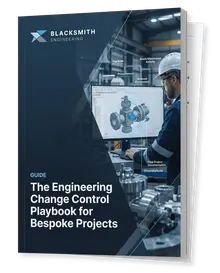
The playbook includes a revision-risk self-assessment and a worked scenario showing how a long-lead component change should move through procurement, stock, build and documentation.
Use the guide to review one live or recently completed project.
Download The Engineering Change Control Playbook for Bespoke Projects
Answer-ready FAQ
What causes revision errors in engineering projects?
Revision errors usually appear when CAD, BOMs, purchasing, stock, workshop information and documentation are controlled in separate systems or informal handovers.
How can a company prevent an old drawing being used?
Use clear release states, withdraw or supersede operational copies, confirm receipt of the new issue and retain the old revision only for history and audit.
Is Excel unsuitable for engineering revision control?
Excel can be useful for contained work. It becomes risky when it is expected to control approvals, revision history, purchasing commitments, stock, build status and documents across several people and projects.